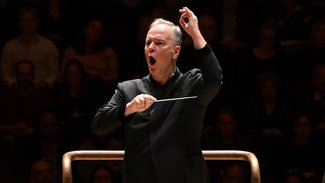
Sakari Oramo combines symphonic landmarks by Britten, Brahms, Debussy, Dvořák, Mahler, Shostakovich and Stravinsky with revelatory companion pieces at this year’s BBC Proms and throughout the BBC Symphony Orchestra’s 2026-27 season.
Conductor’s repertoire explorations include the world premiere of Gwilym Simcock’s Triple Concerto, the UK premiere of Mark-Anthony Turnage’s Festen Suite, Anders Hillborg’s Viola Concerto, and a rare outing for Mendelssohn’s Die erste Walpurgisnacht
Oramo’s seventh time conducting the Last Night of the Proms with Yuja Wang and Nicky Spence as soloists.
‘Oramo is one of those conductors who never imposes his will on a work, allowing the composer to speak his mind through the notes on the page,’ Guardian, 15 March 2026
Musical substance, creative contrasts and repertoire breadth are among the qualities that define Sakari Oramo’s programmes with the BBC Symphony Orchestra throughout the 2026-27 season, his fourteenth since becoming its Chief Conductor. They are clearly present in four concerts to be given at this year’s BBC Proms and again in his appearances during the orchestra’s annual series at the Barbican Centre. Highlights include works by Britten, Kurtág and Mahler at the Proms, premieres of pieces by Mark-Anthony Turnage and Gwilym Simcock, and the compelling combination of Mendelssohn’s Die erste Walpugisnacht, Anders Hillborg’s Viola Concerto and Stravinsky’s The Rite of Spring to the end the Barbican season’s first half.
Oramo opens his latest round of BBC Proms concerts on 22 July with Stele by György Kurtág, given in honour of the composer’s hundredth-birthday year, and Mahler’s Symphony No.6 ‘Tragic’. The Finnish conductor began performing Kurtág’s works over 40 years ago, during his time as a violin student at the Sibelius Academy in Helsinki. “Very few people knew about him outside Hungary then,” he says. “The head of music at the Finnish Broadcasting Corporation brought a manuscript copy of the first part of his Kafka Fragments to Finland and asked us to make a recording of it for the radio. Anu Komsi and I went on to record the complete work in the early 1990s for commercial release.” The duo will reprise their interpretation of Kafka Fragments on Sunday 9 August at the Bristol Beacon as part of the Bristol Proms.
Stele began life as a work for solo piano in 1993; Kurtág orchestrated it the following year while serving as composer-in-residence with the Berliner Philharmoniker. Although its three movements last less than 14 minutes, each contains music of extraordinary density and concentration. “It was one of the first things I thought of as a companion for Mahler Six,” notes the conductor. “The two works share the same spiritual, psychological landscape and are by composers whose music is very intense, very demanding and, in places, very dark.”
Sakari Oramo returns to the Royal Albert Hall with the BBC Symphony Orchestra on Tuesday 28 July. Their second Proms outing opens with the UK premiere of Mark-Anthony Turnage’s Festen Suite, constructed from material drawn from his eponymous opera, which in turn is based upon Thomas Vinterberg’s cult film. “My relationship with Mark’s music goes back a long way,” says Oramo. “I gave the Finnish premieres of his Blood on the Floor and Three Screaming Popes and, more recently, the UK premiere of Time Flies with the BBC Symphony.”
Turnage’s recent score is presented in company with Benjamin Britten’s Symphony for Cello and Orchestra, with Guy Johnston as soloist. “What I love about this piece is the flair with which Britten writes for every part of the orchestra, not to mention the virtuosic solo music he originally wrote for Mstislav Rostropovich.” The concert’s second half is devoted to Sibelius’ Symphony No.2, a work from the heart of Oramo’s repertoire. “I’ve done astonishingly few Sibelius symphonies at the Proms,” he recalls. “The idea arose that it was time to start doing more.”
Britten’s A Young Person’s Guide to the Orchestra provides a suitably rousing introduction to Sakari Oramo’s Proms programme on Sunday 6 September, given to mark the 80th anniversary of the showpiece work’s first performance and the 50th anniversary of its composer’s death. It will be followed by a new Triple Concerto for saxophone, horn and cello by Gwilym Simcock, with Jess Gillam, Ben Goldscheider and Sheku Kanneh-Mason as soloists, reunited a decade after they contested the final of the 2016 BBC Young Musician competition. Dvořák’s evergreen Symphony No.9 ‘From the New World’ stands alone in the concert’s second half. “I’ve only performed parts of the Britten before, for an education project, I think, with the City of Birmingham Symphony Orchestra,” Oramo confides. “It’s a great piece with something for every player. And I look forward to discovering Gwilym Simcock’s Triple Concerto, which is probably unique in its combination of solo instruments. It will be fun, for sure.”
Sakari Oramo presides over the Last Night of the Proms on Saturday 12 September, the seventh time he has conducted the festival’s famous closing celebration. “We will have a more substantial first-half programme this year than has become usual in recent times,” he says. “The traditions of the second half will be respected but, as always, with a bit of a twist!”
The BBC Symphony Orchestra and its Chief Conductor are set to undertake a tour to Poland and Bulgaria this autumn, complete with concerts in Katowice, Warsaw and Varna. They return to the Barbican Centre on Friday 23 October to launch the orchestra’s London season with a programme comprising the Four Sea Interludes from Britten’s Peter Grimes, Shostakovich’s Cello Concerto No.1, with Senja Rummukainen as soloist, the UK premiere of Francisco Coll’s Elysian and Debussy’s La Mer. “It’s a very rare instance of me conducting Russian music but I am doing it because of the very close relationship between Britten and Shostakovich.”
Conductor and orchestra join forces again at the Barbican on Tuesday 10 November to perform Enescu’s Romanian Rhapsody No.1, Bartók’s Violin Concerto No.1, with soloist Inmo Yang, winner of the 2022 International Jean Sibelius Violin Competition, and Brahms’s Symphony No.1. “This is a lovely programme,” observes Oramo. “It places the emphasis on music composed in East-Central Europe and the old Austro-Hungarian Empire, an endlessly fascinating part of the world.”
The first half of the BBC Symphony Orchestra’s season concludes on Friday 4 December with a beguiling triple bill. The programme opens with Mendelssohn’s cantata Die erste Walpurgisnacht, a dramatic setting of verse by Johann Wolfgang von Goethe for four solo voices, chorus and orchestra, first published in its final form in 1843. Lawrence Power will take the solo lead in Anders Hillborg’s Viola Concerto, which was written for and first performed by him in 2021, before the concert closes with Stravinsky’s The Rite of Spring. “I was keen to find something fresh for the BBC Symphony Chorus to do and Die erste Walpurgisnacht is a wonderful piece for them,” says Oramo. “We’ll be looking ahead to springtime renewal with the Mendelssohn, which concerns pagan rituals held on May Day, and Stravinsky’s unequalled response to the creative force of spring.”