Good News from Mumbai:
Martyn Brabbins has bold plans for the Symphony Orchestra of India as he takes up the reins as its Chief Conductor. He tells Andrew Stewart of his admiration for its players and shares his hopes for their future work together.
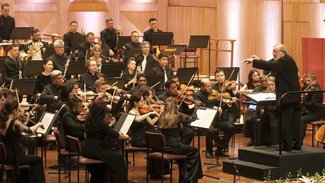
These are exciting times for Mumbai. India’s financial and cultural hub, on the rise in so many ways, continues to draw the world’s attention with ambitious new developments and eye-catching creative projects. The city’s international reputation is set to receive a boost this year with the arrival of Martyn Brabbins as Chief Conductor of the Symphony Orchestra of India. It would be hard to overstate the critically acclaimed ensemble’s achievements at home as India’s first and only fully professional western orchestra or overseas as a touring ambassador for the nation. The beginning of Brabbins’ tenure, which commenced on New Year’s Day, opens a compelling new chapter as the SOI enters its twentieth anniversary year.
“The Symphony Orchestra of India is a good news story,” says the British conductor. “How many symphony orchestras have been established in the last two decades? Very few! The energy and openness of what's going on here are amazing. That’s very attractive. There’s an enthusiasm both from within the orchestra – from the overseas players who come back time and time again to play with it, and from the nucleus of musicians who are in Mumbai year-round. We have a cohort of top-class players who take time out of their jobs to come to play with the orchestra. They create a wholly positive working environment, with their camaraderie and passion, and give their best all the time.”
Brabbins pays tribute to Khushroo N. Suntook, the indefatigable co-founder of the Symphony Orchestra of India and Chairman of its Mumbai home, the National Centre for the Performing Arts. “Khushroo leads in the most extraordinary way. Although he has this incredible life behind him, with a great and long career in business before he came to the NCPA, he's such a humble and generous human being. He never wants anything to be about him, and that chimes well with me. I'm interested above all in the orchestra doing its best. And if I'm involved, then just like Khushroo, I'm fully involved. I think that's perhaps why we get on so well. It's wonderful to be part of that. When I mention the Symphony Orchestra of India to people in Europe, they often say, ‘I didn't know there was an orchestra in India’. In a sense, why should they? But here it is and it's flourishing. And it's ambitious, in all the right ways. I intend to work with the players to build on this terrifically strong platform.”
Martyn Brabbins made his debut with the SOI in September 2016. He has returned to work with the orchestra in Mumbai several times since, was on the podium for its first tour of the United Kingdom at the start of 2019 and has forged close ties with its players and management. The strength of their relationship will be on display when Brabbins launches the SOI’s spring season on Saturday 7 February at the National Centre for the Performing Arts. Their programme opens with the ravishing Prelude to Mussorgsky’s opera Khovanshchina before they launch the orchestra’s first complete Beethoven cycle with the composer’s Symphony No.1. The concert’s second half is devoted to Gustav Holst’s The Planets, a work emblematic of its conductor’s commitment to music by British composers.
The Symphony Orchestra of India crossed Brabbins’ radar long before their first meeting. He learned of its existence from the SOI’s founding Artistic [BM1] Director, Marat Bisengaliev, whom he had known since the early 1990s. The Kazakh violinist invited his colleague to conduct the orchestra several times; the dates suggested, however, always clashed with existing commitments. “When I finally worked with them, we hit it off,” Brabbins recalls. “It's just such a great place to make music. I love it.” He adds that the SOI’s membership, drawn from an international pool of Russian-trained musicians and a core group of local players, gathers in Mumbai with the clear intention of achieving the highest standards in performance.
“We work hard together,” notes Martyn Brabbins. “That's the thing. They're not like a festival orchestra which only meets once a year. But because they work together less often than a full-time orchestra, you do have to build them up with each visit. That happens quite quickly now in rehearsal, so we reach the level that we want to reach much sooner than when I first visited 10 years ago. I'm really excited about the whole situation. Even though we stand outside authentic Indian culture, it feels like the Symphony Orchestra of India is embraced and appreciated by our wonderful audience in Mumbai. They’re ready to come on the next part of the journey with us. That’s great for the orchestra’s future.”
SOI Season Highlights at the National Centre for the Performing Arts
The Symphony Orchestra of India’s forthcoming spring and summer seasons contain repertoire guaranteed to project an orchestra’s prowess. Martyn Brabbins opens on Saturday 7 February with works by Mussorgsky, Beethoven and Holst. His second concert of the year, to be given at the NCPA on Thursday 12 February, includes Mendelssohn’s concert overture Calm Sea and Prosperous Voyage, Mahler’s Lieder eines fahrenden Gesellen, with Dame Sarah Connolly as soloist, and Shostakovich’s Symphony No.10. Carlo Rizzi arrives as guest conductor the following week. The Italian maestro offers the generous pairing of Dvořák’s Symphony No. 8 and Sibelius’ Symphony No.2 on Tuesday 17 February before exploring orchestral works by Rossini and Puccini, songs by Tosti and Cardillo (with rising-star tenor Davide Giusti), the Prelude to Act III of Wagner’s Lohengrin, and Beethoven’s timeless Symphony No. 5 on Saturday 21 February.
Martyn Brabbins is eager to expand his band’s repertoire. Bartók’s Concerto for Orchestra is high on his wish-list, as is a broad sweep of works by British composers, and symphonies by, among others, Bruckner and Mahler. The direction of travel is signposted in his programmes this summer, which start on Sunday 16 August with the combination of Beethoven’s Symphony No.2 and Richard Strauss’s tone poem Also sprach Zarathustra. The concert also includes Mozart’s sublime Clarinet Concerto with renowned Belgian virtuoso Annelien Van Wauwe as soloist. Brabbins’ summer season continues with another imaginative menu of compositions on Friday 21 August, comprising the Prelude to Wagner’s Parsifal, Shostakovich’s Cello Concerto No.1, with Canadian-born, Berlin-based cellist Bryan Cheng as soloist, and Elgar’s majestic Variations on an Original Theme ‘Enigma’.
Two programmes directed by Alessandro Bonato, hailed as one of Italy’s finest conductors, are certain to highlight the Symphony Orchestra of India’s versatility and finesse. The first, scheduled for Wednesday 26 August, is set to include Mendelssohn’s Symphony No.4 ‘Italian’, while Bonato’s choice of repertoire for the final concert of the orchestra’s 2026 season at the NCPA on Sunday 30 August will be built around Beethoven’s Symphony No.8.
Stepping Up:
As the Symphony Orchestra of India marks its twentieth anniversary, Andrew Stewart talks to its co-founder, Khushroo N. Suntook, about past achievements, present projects and future prospects.
Western classical music may occupy a narrow niche within India’s rich and complex cultural landscape. Yet its past runs surprisingly deep and its future appears bright thanks to the pioneering work of the Symphony Orchestra of India. Khushroo N. Suntook, the orchestra’s co-founder and driving force as Chairman of Mumbai’s National Centre for the Performing Arts, is determined to build on firm foundations set down during its first twenty years. He holds a clear understanding of its present artistic qualities and an equally clear vision of how these might be developed, with both aspects informed by a deep personal knowledge of the story of classical music in his home city.
The creation of India’s first and only fully professional symphony orchestra, remarkable in itself, has been followed by a sustained period of growth and impressive artistic progress. The trend is set to continue with the arrival in post of Martyn Brabbins as the SOI’s Chief Conductor and the launch of an ambitious series of concerts designed to mark the orchestra’s twentieth anniversary. “Many people have tried to form a classical orchestra here in the past,” recalls Khushroo N. Suntook. “Some managed to give concerts and attain a certain standard. But we wanted to go well beyond that, and I believe we have. People have written that we compare with fine international orchestras. That's a good first step. I think.”
The Spectator, Britain’s venerable weekly political and cultural news magazine, prefaced the Symphony Orchestra of India’s inaugural UK tour in 2019 with an article headlined ‘Miracle of Mumbai’ and containing its author’s considered assessment of what he called a ‘world-class ensemble’. Truly, a good first step. The orchestra’s next step will be taken in company with Martyn Brabbins. The British conductor, former music director of English National Opera and current chief conductor of the Malmö Symphony Orchestra, is known as a ‘musicians’ musician’, a coveted accolade earned over the course of a career that began in the late 1980s.
“Martyn is no stranger to our orchestra,” says Suntook. “He conducted them on nine occasions here in Mumbai at the National Centre for the Performing Arts (NCPA) and during our first UK tour, but was never available to take on a formal role until now. We found him to be very compatible with the players, a very pleasant gentleman, who suited the temperament of our musicians. I think that's so important. The old days of conductors like Toscanini and Szell, whose orchestral players did as they were told, no longer works. Having been an orchestral player himself, Martyn empathises with the musicians.”
Brabbins, who studied conducting with the legendary Ilya Musin at the Leningrad Conservatory, experienced the same Soviet system that produced the SOI’s founding Artistic Director, Marat Bisengaliev, and many of the Kazakh and Russian musicians who have been regulars with the orchestra since its inception. “Because of Marat’s involvement from the beginning, there has always been an orientation towards players trained in the Russian school,” notes Khushroo Suntook. “When we asked him to build the orchestra, I told him he must also build a programme to have Indian musicians in it as fast as possible. ‘Yes, yes,’ he replied, ‘but only if they measure up to my standards – and that will take a few years.’ ‘How many?,’ I asked. ‘Maybe 15, maybe 20?’ Oh dear, I thought. Marat started with auditions, with 100 Indian musicians auditioning for the first violins. He got three or four in the first round, some of whom are still with us[SH1] !” The SOI Music Academy, launched under Bisengaliev’s leadership in 2012, has helped construct a complete musical ecosystem at the NCPA.
During its twentieth anniversary year, the Symphony Orchestra of India will field around 15 Indian musicians. They will take their place in a multinational workforce comprising 110 players from 16 countries[BM2] . “The orchestra will play all over India this year as well as in Mumbai,” says Suntook. “As always our main season at the NCPA, with leading international artists and conductors, takes place in February and August, and there will be one-off projects in addition.” The latter include a collaboration this October with the NCPA’s dance department and the Kathak dancer and choreographer Aditi Mangaldas. “She's a great artist! And so we will have a dissemination of western classical music and our Indian dance traditions. We also staged two fantastic days at the end of last year in honour of the tabla player and composer Zakir Hussain, who died in 2024. He was like a semi-god in India. Fifty musicians came from all over the world to play without taking a fee.”
Hussain’s Peshkar, among the world’s first concertos for tabla and orchestra[BM3] , was commissioned by the Symphony Orchestra of India for its tour to Switzerland in 2016 and included in the repertoire for its UK debut three years later. His Triple Concerto for tabla, sitar, bansuri and orchestra was on the bill for the orchestra’s second tour of Britain in 2023, programmed together with works by Beethoven, Brahms, Khachaturian, Rossini, Richard Strauss, Stravinsky, Wagner and John Williams. The SOI’s touring schedule has also taken the orchestra to Oman, Abu Dhabi, Russia, Georgia and, last September, Kazakhstan, while its rising status has attracted conductors of the calibre of Zubin Mehta, Charles Dutoit, Sir Mark Elder, Alexander Lazarev, Andrew Litton, Rafael Payare, Yuri Simonov and Carlo Rizzi. The latter will head from Mumbai to New York following his February concerts with the SOI for Madama Butterfly rehearsals at the Metropolitan Opera.[SH4] Operalia, the competition for opera singers founded by Plácido Domingo, came to South Asia for the first time in its 31-year history in September 2024, hosted by the NCPA and supported by the Symphony Orchestra of India.
“Mumbai has a huge tradition of receiving soloists,” observes Khushroo Suntook. “Bessie Abbott, who sang with Caruso, was the first to come here in the early 1910s, followed by the great lyric coloratura soprano Amalita Galli-Curci. Jascha Heifetz came three times, really. Arthur Rubinstein came and the Czech Philharmonic, the greatest orchestra of all, in my opinion, so too did Benjamin Britten, Peter Pears, Claudio Arrau. Rudolf Serkin. We had the Vienna Philharmonic playing at my old college. Now add to that the international soloists that have performed with us – artists such as Angel Blue, Sir Stephen Hough, Alina Ibragimova, Steven Isserlis and Maria João Pires – and you see the status that we’ve already achieved. And so things are moving for us, most definitely.”
Thanks to financial assistance from the Tata group of companies, the NCPA will see the reconstruction of one of its five theatres and receive funding to support some of its programmes [BM5] over the next three years. Suntook and his colleagues have also secured sponsorship pledges from Mumbai businesses. The NCPA’s Chairman was elected to the Executive Committee of the Association of Asia Pacific Performing Arts Centres (AAPPAC) last October, a reflection of the international status he and his organisation have attained. “I’m optimistic about the Symphony Orchestra of India’s future,” he says. “What interests me, above all, is the continued improvement in the quality of our performances.”
Change Makers:
With student numbers at an all-time high and alumni gaining places at prestigious international colleges, the SOI Music Academy has become a centre of excellence for training the next generation of India’s orchestral musicians. Martyn Brabbins, Khushroo N. Suntook [SH1] and Marat Bisengaliev discuss its story with Andrew Stewart.
Large corporations and even governments would be wise to look to world-class symphony orchestras for models of productive collaboration, focused teamwork and effective management. The point is clear for all to see in the Symphony Orchestra of India, where players from around 15-16 countries combine to create a cosmopolitan group devoted to the pursuit of excellence. Indian musicians provide around one sixth of the present ensemble’s multinational membership, comprising 11 full-time players and four trainees. [BM2] Additional freelance Indian players are often employed, lifting the total number of native musicians to 20. It’s a striking figure given the historically patchy range of training in western classical music available to young people in Mumbai and beyond. The drive to recruit native players continues to gather pace thanks to the work of the SOI Music Academy, an inspired and inspiring initiative rooted in the fertile ground of the Russian school of instrumental training.
Although the number of teaching rooms available at the National Centre for the Performing Arts means that the SOI Music Academy’s student roll has reached its limit, demand from prospective candidates has certainly not. Today’s cohort of students stands at 69, a year-on-year increase of 30% above its 2024 tally. Responsibility for their training has fallen under the care of the Symphony Orchestra of India’s Artistic [BM3] Director, Marat Bisengaliev, since the Academy was founded in 2012. “The SOI Music Academy was founded with the vision of building a centre of excellence that could shape orchestral musicians of true international calibre,” he says. “As we look forward to the coming year, I am deeply proud of the Academy’s students and alumni whose successes on national and global stages affirm our vision. I am continually inspired by the growing number of admission enquiries each year, which reflects the Academy’s standing and the increasing aspiration among parents for their children to receive formal, world-class musical training.”
Bisengaliev oversees a team of 2[BM4] 7 teachers, each a regular with the SOI, which provides one-to-one tuition to students on their primary instruments across a seven-year foundation course and an extensive diploma course spanning 11 years. The Academy’s holistic curriculum also delivers second-study piano lessons, classes in music history and theory, group singing sessions informed by the invaluable solfeggio method of aural training, and coaching in orchestral and chamber music playing.
Around three to five Academy students are invited to join the SOI each season. [SH5] The SOI Music Academy Orchestra has performed in Abu Dhabi, gives a concert at its home base every April, and appears at other cultural events and venues across Mumbai, Art Mumbai and MuSo among them, for young audiences. Former students have gained places at Manchester’s Royal Northern College of Music, Vanderbilt University in Nashville and the University of Warwick, while Academy students have won prizes at, among others, Vienna’s Golden Key Music Festival and the Moyse International Flute Competition in Sofia. A two-year trainee programme, supported by Citi Bank, offers additional opportunities for Indian players aged 18 and above to acquire the skills required to become members of the orchestra.
Martyn Brabbins looks forward to welcoming more SOI Music Academy and SOI [BM6] trainees into the orchestra’s ranks. “I've met some of the Academy’s incredibly talented young players and have faith in the quality of the tuition they're receiving,” he says. “Many of their teachers studied in Russia. Now there's a whole phalanx of Kazakh and Russian musicians working at the orchestra’s Academy. We all know about their high standards and rigour. I spent two years myself studying in Russia during Soviet times and know how there's an expectation from that system of hard work, dedication and graft. I think that approach has already paid off with many of the Academy’s youngsters. There's a huge enthusiasm there. So, we're hoping that in 10 years’ time, or sooner, more of its graduates will feature as members of the orchestra. If one is given opportunities of the kind offered by the Academy, who knows where they'll lead?”
The Symphony Orchestra of India’s outreach work extends far beyond its Mumbai school. Academy teachers travel to Goa and Kalimpong to work with underprivileged music students and help improve their skills. Members of the orchestra, meanwhile, regularly play popular classical programmes at Mumbai’s open-air bandstands as part of the NCPA@thePark series[BM7] , launched during Covid times, while the SOI Chamber Orchestra presents a monthly concert series at Prithvi Theatre in the city’s coastal suburb of Juhu. “It's where all the cinema actors and actresses perform, so it's very popular,” notes Khushroo N. Suntook. “It's a small hall with a small stage, a place where our chamber orchestra has built a loyal following. It is formed from around 35 players who are resident throughout the year in Mumbai. We also present chamber music recitals there. It's a very popular place and so are the concerts.”
Connecting with new audiences and supporting young musicians, adds Suntook, rank high on the Symphony Orchestra of India’s list of priorities as it enters its third decade. The organisation’s strategic mission for education and outreach includes a growing number of concerts designed for families and young people and a continuation of its popular programme of occasional performances of opera in concert. “There is now an extensive programme of western classical music that will run in harness with our great tradition of classical and contemporary Indian music here at the National Centre for the Performing Arts,” its Chairman concludes.”